
Enterprise Translations Office

From fragmented use of AI tools in communication for effective linguistic accessibility
The State of Minnesota's Enterprise Translations Office (ETO) was established to solve a practical problem in the public sector: public information was not reaching everyone as long as translation work remained time-consuming, fragmented, expensive, and inconsistent.
Summary of the effect at ETO
3,9
million USD
estimated savings and other values
25+
public agencies served
99 %
satisfaction
50 000+
public servant officer
The public cannot be for everyone if it only speaks to a few
Translation is not just a linguistic task. It is a core function of public service delivery.
A fragmented system that couldn't scale
Before the ETO was established, translation work across Minnesota state agencies was handled in a fragmented manner. Different agencies—and in some cases, even departments within the same agency—had their own processes for translating public information.
Some teams worked directly with external vendors. Others relied on internal staff. Some had established work processes, while others only handled translations when an urgent need arose.
The result was predictable: uneven quality, long delivery times, duplicated efforts, varying costs, and a lack of overall visibility across the state.
A single translation request often had to go through several manual steps before reaching the right person. The agencies had different expectations regarding quality, formatting, terminology, and delivery time. External-facing content could be well-translated in one area but handled in a completely different way elsewhere.
The problem wasn't a lack of willingness from the agencies to ensure linguistic accessibility; they cared a great deal. The problem was that the operating model wasn't built to scale.
At the same time, artificial intelligence was making its way into the daily work lives. The agencies were interested in using new tools to improve service delivery, but they also needed practical guidance on data privacy, human oversight, risk management, and proper use.
Minnesota needed more than just faster translation. The state needed a controlled model for multilingual communication and responsible use of AI in real, public work processes.
Translation must become a core competency in the public sector
The Enterprise Translations Office was established to bring structure, continuity, and accountability to the state's translation efforts.
The purpose was practical: to help agencies communicate with residents in languages they understand, while improving speed, quality, cost control, and coordination.
ETO was built around three core tasks:
Provide translation services: ETO provided internal translation services for departments and agencies, including support in Spanish, Somali, and Hmong.
Support localized public information: ETO contributed to translating and maintaining outward-facing information from the state, allowing citizens access to important public services in languages other than English.
Set standards and guidelines ETO became a resource center for translation standards, best practices, vendor coordination, quality assurance, and general guidance for public sector translation.
As the work progressed, the ETO also became a practical example of how artificial intelligence can be implemented responsibly in public operations.
Under Adam Taha's leadership, ETO developed guided, AI-supported workflows, and assisted other public agencies in considering their own guidelines, security mechanisms, and implementation routines for AI. This included support and expert input to, among others, the Minnesota Department of Administration, the Department of Human Services, and the Department of Public Safety.
This made ETO more than just a translation team. It became a centralized operational model for linguistic accessibility, responsible AI implementation, and practical management in public work processes.
From supplier dependency to coordinated operation
This changed the translation process by consolidating all requests into a more controlled workflow.
Instead of each agency handling its translation needs independently, ETO created a shared model that could receive requests, assess content, assign tasks, apply quality standards, and deliver completed translations in a far more consistent manner.
This reduced fragmentation. It also gave agencies a clearer path to get public information translated, without them having to reinvent the wheel each time.
The change was not only organizational, it was also technological.
ETO introduced AI-assisted workflows to help language specialists work faster, while keeping human quality assurance at the center of the process.
The same model also showed other agencies how AI could be used responsibly: with defined use cases, guidelines, human oversight, data handling rules, quality assurance, and documented control.
As a result, ETO's impact extended far beyond mere translation. The office helped normalize a more disciplined approach to the adoption of AI across Minnesota state agencies, where innovation was paired with governance, accountability, and the goals of service delivery.
ETO showed that artificial intelligence can improve public services without removing human judgment or undermining trust in society.
During its first year of operation, ETO became a model for resource-efficient and scalable service delivery in the public sector:
A team of six people covered the translation needs across more than 25 agencies and a public workforce of over 50,000 employees.
The drift model
Human-centered AI – not an AI replacement
ETO's model was built on a simple principle:
Artificial intelligence can help speed up translation work, but human subject matter experts must retain responsibility for quality, context, terminology, and final delivery.
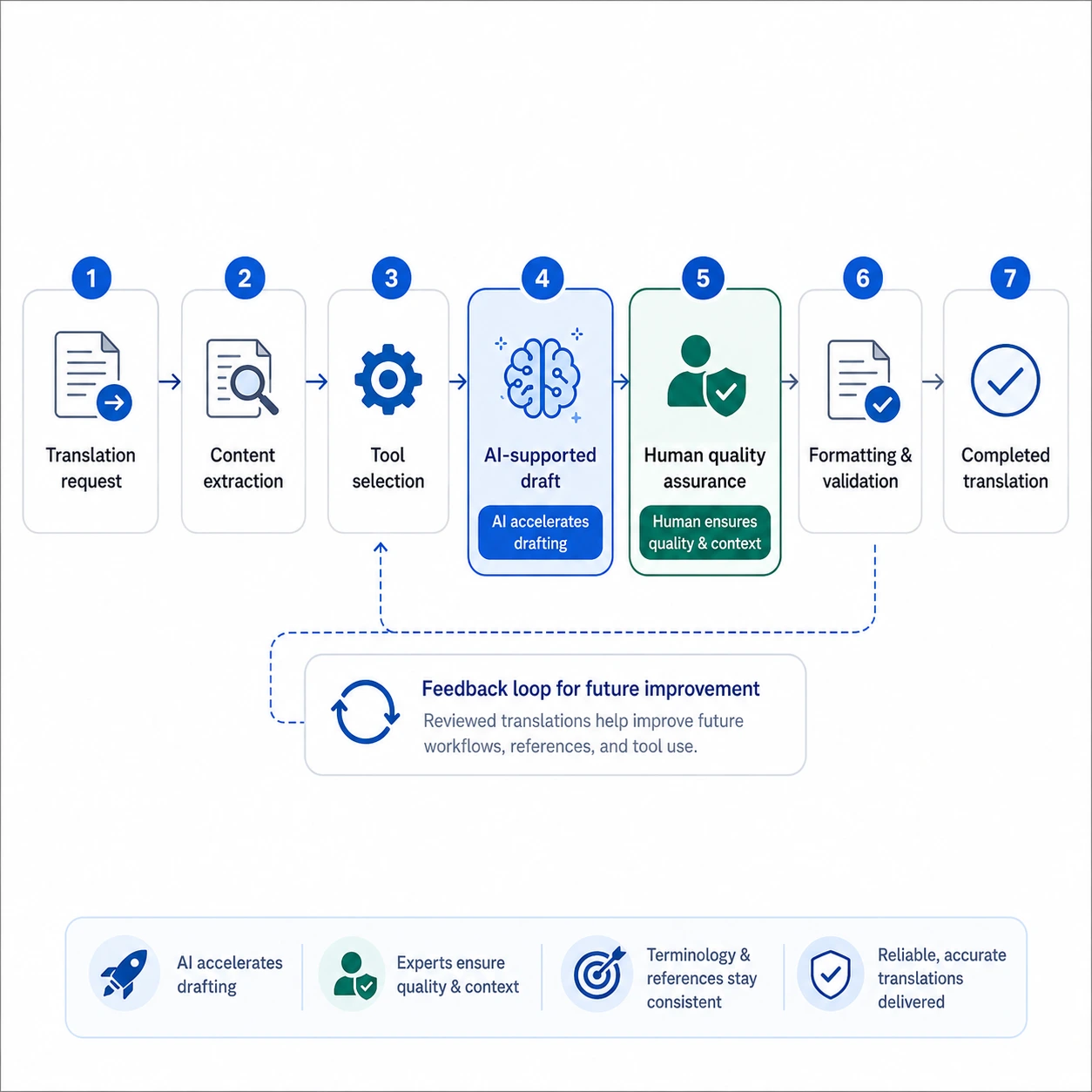
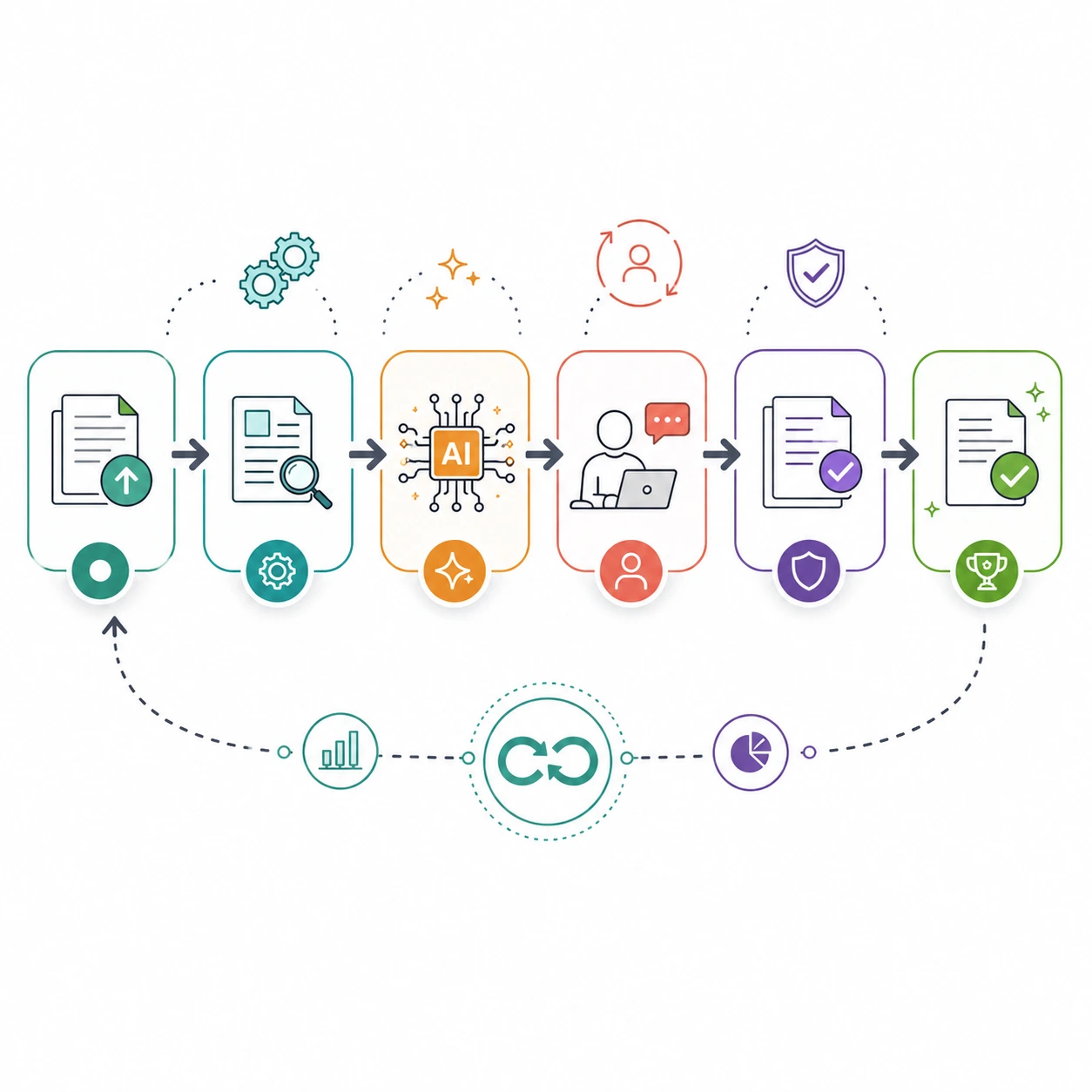
The work process combined technology and human judgment:
Translation request
Content extraction
Tool selection
AI-assisted first draft
Human quality assurance
Formatting and validation
Translation complete
Feedback loop for future improvement
This was the core of the model:
ETO did not treat translation as a purely data conversion problem. They treated translation as communication. This meant that speed was important, but so were meaning, tone, trust, and cultural accuracy.
Control and security mechanisms
AI needed rules, not just access
Adopting artificial intelligence in public translation work required more than just a tool subscription. It required governance.
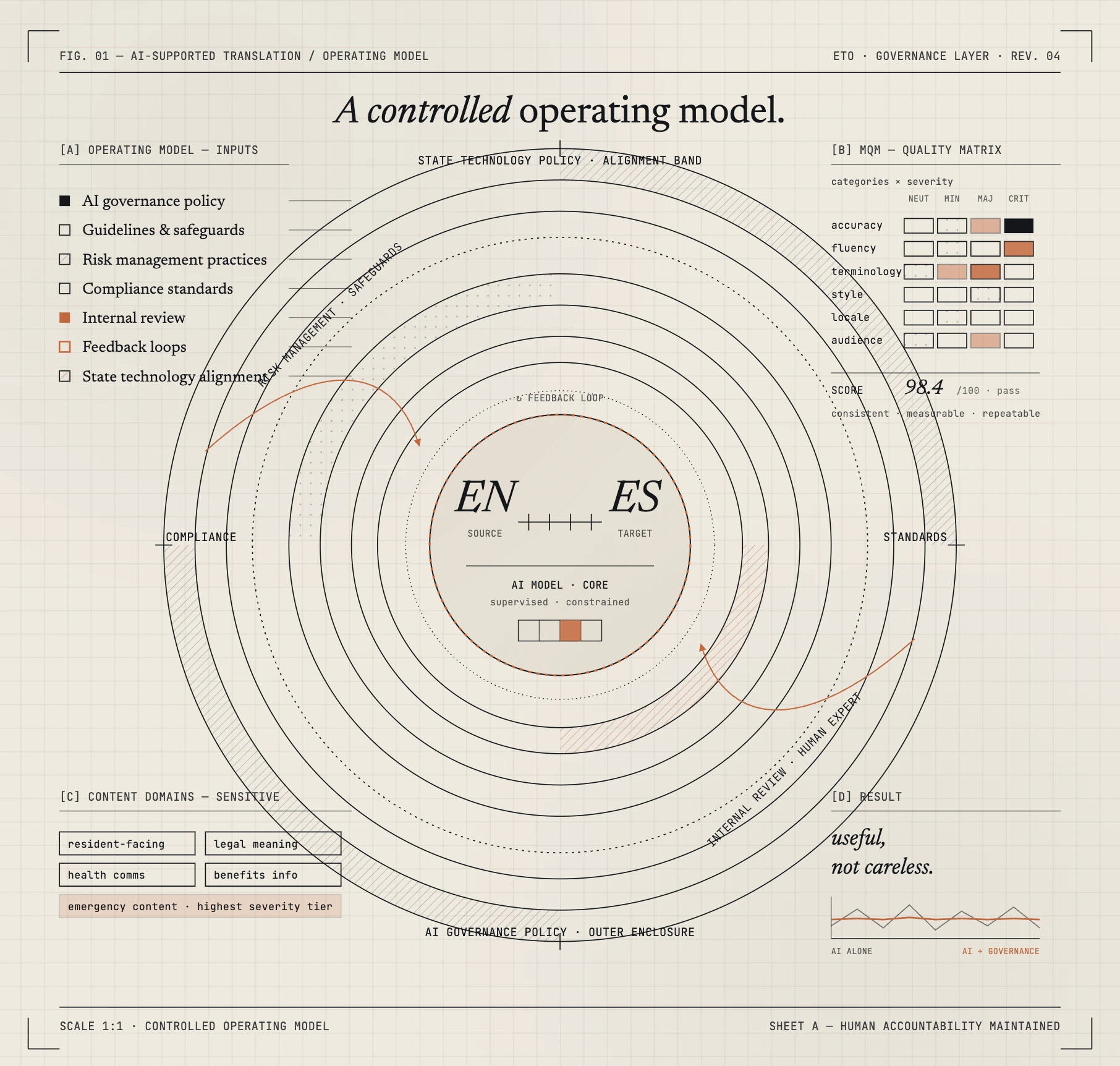
ETO's AI-supported model operated with internal security mechanisms, guidelines, control procedures, and compliance with the state's technological requirements. The goal was to make artificial intelligence useful without the process becoming careless.
The model included:
Strategy for AI Governance
Guidelines and Safety Mechanisms
Risk Management Practice
Compliance standards
Internal Quality Assurance
Feedback loops
Harmonization with the State's IT Guidelines
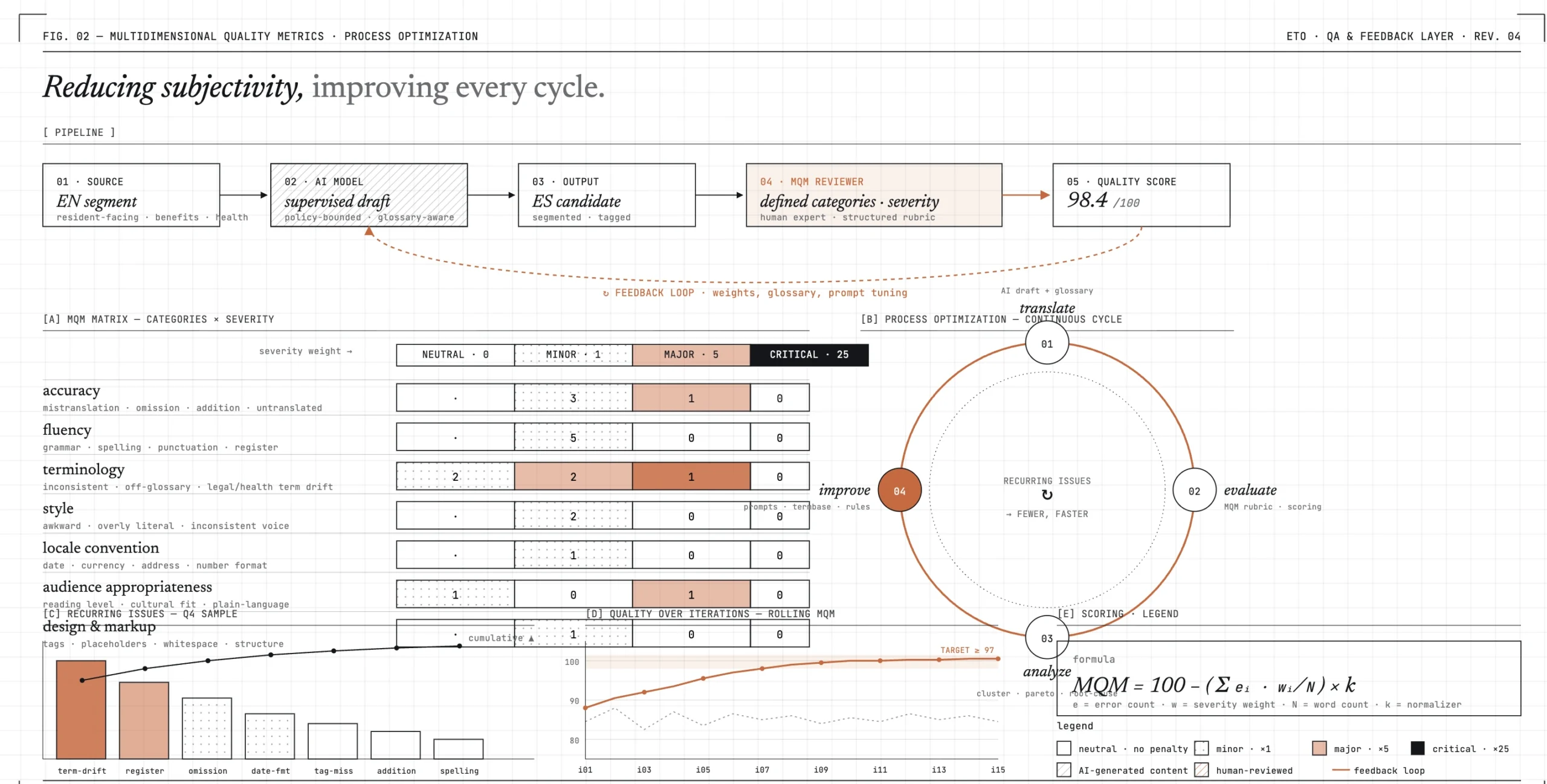
ETO also adopted the MQM method.Multidimensional Quality Metricsto strengthen the quality assurance of translations. Instead of relying solely on the proofreader's personal preferences, MQM made it possible to evaluate translations through defined quality categories, error types, and severity levels.
This helped to reduce subjectivity in human review and made quality assessment more consistent, measurable, and repeatable.
The results were highly successful. MQM provided ETO with a practical way to combine human expertise with structured evaluation, making it easier to identify recurring issues, improve future outcomes, and maintain quality across different languages and agencies.
This steering committee was crucial because translations in the public sector can involve sensitive information, citizen-facing guidance, legal significance, health communication, welfare benefit information, and emergency messaging.
ETO showed that AI-assisted translation can work well in the public sector when placed in a controlled operating model with human responsibility, quality metrics, and clear rules.
Results and operational impact
ETO showed that a small, specialized team in the public sector could improve translation speed, reduce duplication of effort, strengthen quality control, and influence the adoption of responsible AI across state agencies.
Faster and more accurate communication
ETO reduced delivery times from weeks to days, and urgent requests could often be completed in just a few hours. Faster translation meant faster access to public information.
Better cost control
ETO generated $1.72 million in verified avoided costs for fiscal year 2025 (FY25), and was projected to generate a value of $2.15 million in fiscal year 2026 (FY26). This totals around $3.9 million over the office's first two years of operation.
Greater scalability
During its first year of operation, ETO demonstrated what resource-efficient innovation in the public sector can achieve. With a team of six, the office covered the translation needs across more than 25 agencies and over 50,000 public employees.
Responsible AI Introduction
ETO's effect extended far beyond mere translation. Under Adam Taha's leadership, the program helped public agencies develop practical AI guidelines, security mechanisms, human oversight models, and data handling rules.
More accessible public transportation
ETO transformed translation from a scattered support function into a more reliable core function for public service delivery, helping citizens access public information in languages other than English.
Recognition and external validation
ETO's work was recognized across the public sector, technology communities, and artificial intelligence professional circles.

What does this mean for a Norwegian business?
The Minnesota model should not be copied as an American organization. It should be translated to fit Norwegian requirements, Norwegian work processes, and Norwegian risk profiles.
For Norwegian businesses, the lesson is about building a controlled operational model for language, AI, people, and data. This means that multilingual communication is not merely treated as isolated translations, but as a workflow with clear intake, assessment, processing routing, quality assurance, approval, and documentation.
Translated to Norwegian needs, it means:
Documented treatment pathways
Content must be evaluated before it is sent to AI tools, suppliers, or internal reviewers. This provides a better basis for internal control, privacy assessments, GDPR documentation, and safer handling of sensitive information.
Terminology control and human approval
Public communication must be correct, understandable, and tailored to the target audience. AI can support the work, but professionals must retain responsibility for meaning, context, terminology, plain language, and final approval.
Proper distinction between translation, guidance, and interpretation
Not all language needs should be solved in the same way. Some needs apply to written translation. Others apply to multilingual guidance. In situations where the citizen and the organization must understand each other properly, the need may apply to an interpreter. The workflow should therefore support the assessment of the need for an interpreter, the use of a qualified interpreter, exception assessments, and guidelines for booking and use.
First step in Norway
For most businesses, the first step is not a major platform acquisition. The first step is a fixed-price, limited AI and language exposure analysis, where the business gains an overview of language interfaces, tool usage, document types, data flow, risk, and necessary control measures.
Vil dere forbedre arbeidsflyten for oversettelse?
Bestill en uforpliktende samtale på 30 minutter. Vi tar utgangspunkt i deres språkbehov, verktøy og rutiner og avklarer om en avgrenset arbeidsflytpilot passer.
Dere trenger ikke å sende dokumenter eller personopplysninger fra virksomhetens saksbehandling før samtalen.
